About the Journal
The journal's topics and specialization include scientific and applied aspects of interdisciplinary research, programming and information processes, philosophy of science and technology, as well as issues of training highly qualified personnel in the gaming industry in the modern IT education system aimed at developing and improving the gaming and creative industries.
ISSN: 3033-8905
The advantages and expected contribution
- Are stimulating a dialogue between experimental scientific thought and real industrial practices.
- Development of new ideas and formats in game design, creative industries and multimedia platform solutions.
- Strengthening the position of the gaming industry as a key segment of the creative economy that promotes cultural and scientific exchange.
- Expanding the professional community and opening up opportunities for interdisciplinary research, innovation and commercialization of projects.
Target audience
- Academic researchers and teachers (psychology, sociology, cultural studies, computer science, economics).
- Game developers, designers, producers, marketers.
- Students of creative and technical specialties.
- Business representatives (investors, startups) and politicians interested in the development of the creative economy.
- Artists, musicians, screenwriters, fashion brands focusing on gaming and digital formats.
Current Issue
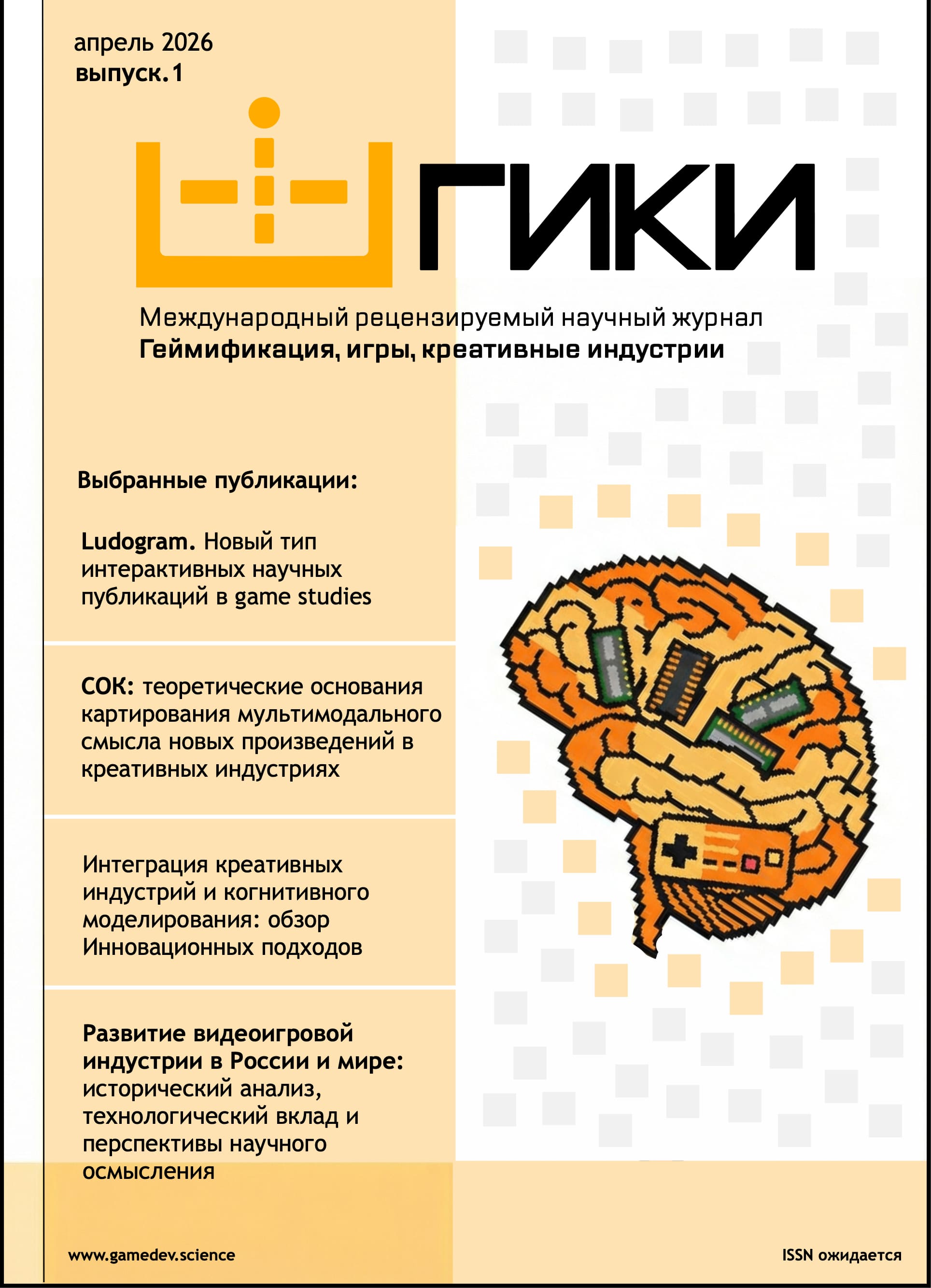
The first issue of the international peer-reviewed journal Game innovations and Creative Industries (GICI) provides an interdisciplinary platform bridging research on video games, interactive media, creative industries, artificial intelligence, and cognitive sciences. The issue opens with a programmatic editorial introducing the concept of the ludogram – a new scholarly publication format that combines an academic text with a reproducible game module, expert annotations, open peer review, and, in experimental versions, the collection of behavioural data.
Key topics of the issue:
-
Game studies: a comprehensive historical analysis of the video game industry’s development in Russia and worldwide, including the contribution of landmark projects (Tetris, IL-2 Sturmovik, Pathologic, Escape from Tarkov) and the role of the Organization for the Development of the Video Game Industry (RVI) after 2022.
-
Technical solutions: point cloud visualization in Unity using Gaussian Splatting; the Quantic Foundry psychometric model for game marketing; AI support for team dynamics in VR; a practical LBE calibration method for Meta Quest 3 and Unreal Engine 5.
-
Creative industries: an overview of integrating cognitive modelling into creative sectors; the immersive visual poetry project VIR.SHI at the intersection of Russian poetry, Chinese calligraphy, and VR.
-
Artificial intelligence: the SOQ system for quantitative assessment of multimodal meaning; a study of university teachers’ competencies in the AI era (based on a survey of 608 students); engineering of neurovisual systems – from model selection to production pipelines.
-
Cognitive sciences: a review of intelligent wearable suits for motion capture and neurophysiological monitoring (TENS/FES, attention mechanisms, closed-loop biofeedback).
-
Student section: an empirical study linking video game genres to motivation and satisfaction of basic psychological needs (Self‑Determination Theory).
The issue is aimed at researchers, developers, educators, students, and anyone interested in the intersection of technology, creativity, and science within the game industry. The journal is published in open access in Russian, English, and Chinese.