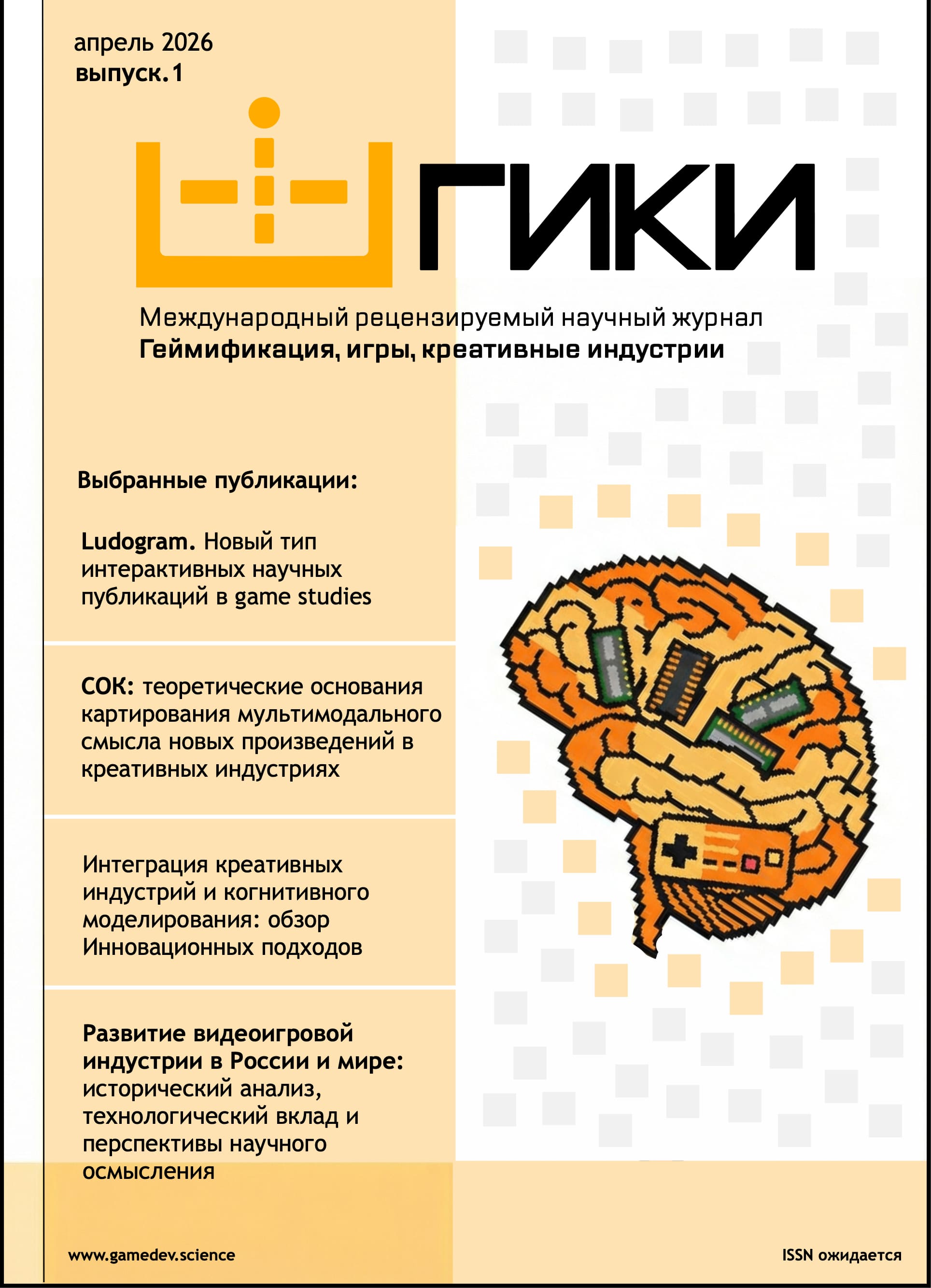
SOQ: theoretical foundations for mapping multimodal meaning in new creative works
Keywords:
multimodal meaning, semantic density, meaning mapping, quantitative methods in art history, AI art, evaluation methodologyAbstract
This article presents the SOQ (Sense, Originality, Quality) methodology for mapping and quantifying multimodal meaning in contemporary art, including works using artificial intelligence technologies. SOQ is positioned not as a ready-made measurement system, but as a proof-of-concept: a conceptual framework and a set of operational components requiring empirical validation. The methodology is built around the concept of a dynamic macronetwork of semantic nodes, each with defined parameters of scale, vitality, source type, novelty, and visibility. The article's main contributions include: an operational definition of a semantic node, the SOQ_total formula with explicitly defined scales and dimensions for all components, a minimal working example of applying the methodology to a specific work, and a validation protocol specifying baselines of comparison. This article is intended for researchers working at the intersection of digital humanities, multimodal semiotics, and the analysis of AI-generated content.
Downloads
Published
How to Cite
Issue
Section
License
Copyright (c) 2026 Станислав Лаук-Дубицкий

This work is licensed under a Creative Commons Attribution 4.0 International License.
The condition of publication is that the authors transfer the copyright or license to publish their articles, including annotations, to the Gamedev and Creative Industries magazine.
The authors who publish in this journal agree to the following terms:
The article is presented on the web pages of the International Magazine "Game innovation and creative industries" and is freely available without charge from readers or his/her institution.
Readers are allowed to download, copy, distribute, print, search, or link to the full texts of an article in the Gamedev and Creative Industries journal without prior permission from the publisher, author, or co-authors.
Gamedev and Creative Industries Magazine is not responsible for the content of the article.
Gamedev and Creative Industries Magazine is exempt from any claims based on the right to privacy or publicity.
After the article is accepted by the Gamedev and Creative Industries magazine and published on its web pages, the author reserves the right to publish it on his personal web pages or distribute it to readers at his discretion.
The authors retain copyright and grant the journal the right to first publish, while the work is simultaneously licensed under the Creative Commons Attribution license, which allows others to share the work with proof of authorship of the work and the initial publication in this journal.
Authors may enter into separate additional contractual agreements for the non-exclusive distribution of the work published in the journal (for example, post it in an institutional repository or publish it in a book) with confirmation of its initial publication in this journal.
You can freely:
- Share — copy and distribute the material on any medium and in any format for any purpose, including commercial.
- Adapt (create derivative materials) — remixing, modifying, and creating new things based on this material for any purpose, including commercial.
- The Licensor has no right to revoke these permissions as long as you comply with the terms of the license.
Subject to the following conditions:
- «Attribution» — You must provide an appropriate indication of authorship, provide a link to the license, and indicate the changes, if any. You can do this in any reasonable way, but not in a way that implies that the licensor approves of you or your way of using the work.
- Without additional restrictions — you may not apply legal restrictions or technological measures that create legal obstacles for others to do anything that is permitted by the license.