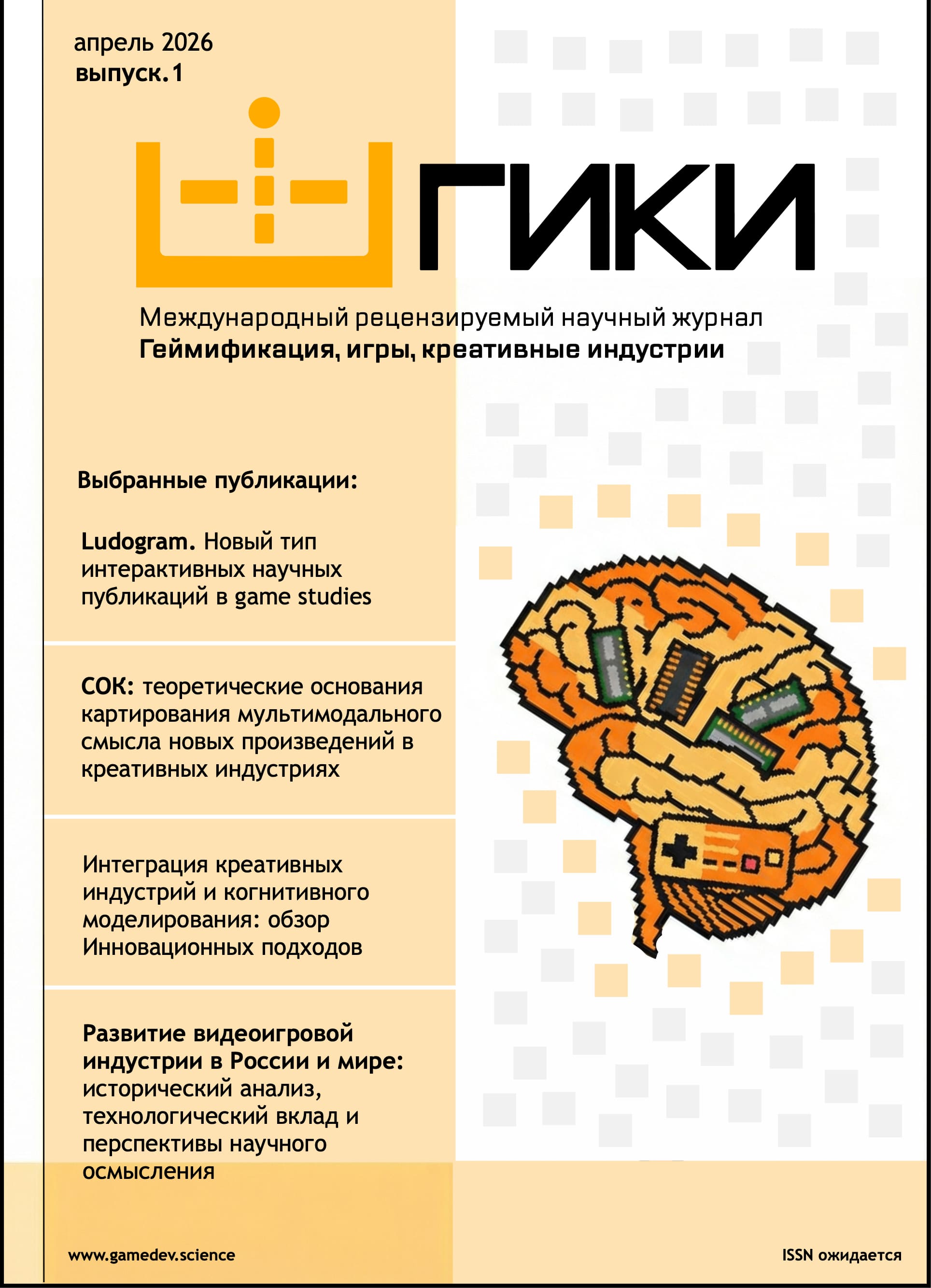
Development of the video game industry in Russia and the world
historical analysis, technological contributions, and prospects for scientific understanding
Keywords:
video game industry, history of video games, Russian game development, game studies, game design, games as a service, digital culture, national school of game design, post-Soviet game industry, Tetris, Escape from TarkovAbstract
This article presents a comprehensive analysis of the evolution of the video game industry as a global sociocultural and technological phenomenon, with particular emphasis on its historical trajectory and the contribution of the Russian school of game development. The study systematizes the key stages of the global market's development, from its earliest experiments to the contemporary era of games as a service. The unique path of the industry's formation in the USSR and post-Soviet Russia is reconstructed in detail, and its distinctive features — shaped by specific historical and economic conditions — are identified. Through the analysis of landmark projects such as Tetris, IL-2 Sturmovik, Allods Online, Pathologic, and Escape from Tarkov, the article assesses the technological and cultural contribution of Russian developers to the global industry and defines the specific characteristics of the "national school" of game design. Special attention is paid to the current state of Game Studies as an academic discipline both in Russia and internationally. The concluding section examines the structural changes in the Russian industry after 2022, the role of the Organization for the Development of the Video Game Industry (RVI) in the processes of adaptation and consolidation of the sector, and offers evidence-based forecasts regarding the prospective directions of its further development.
Downloads
Published
How to Cite
Issue
Section
License
Copyright (c) 2026 Ovchinnikov Vladimir

This work is licensed under a Creative Commons Attribution 4.0 International License.
The condition of publication is that the authors transfer the copyright or license to publish their articles, including annotations, to the Gamedev and Creative Industries magazine.
The authors who publish in this journal agree to the following terms:
The article is presented on the web pages of the International Magazine "Game innovation and creative industries" and is freely available without charge from readers or his/her institution.
Readers are allowed to download, copy, distribute, print, search, or link to the full texts of an article in the Gamedev and Creative Industries journal without prior permission from the publisher, author, or co-authors.
Gamedev and Creative Industries Magazine is not responsible for the content of the article.
Gamedev and Creative Industries Magazine is exempt from any claims based on the right to privacy or publicity.
After the article is accepted by the Gamedev and Creative Industries magazine and published on its web pages, the author reserves the right to publish it on his personal web pages or distribute it to readers at his discretion.
The authors retain copyright and grant the journal the right to first publish, while the work is simultaneously licensed under the Creative Commons Attribution license, which allows others to share the work with proof of authorship of the work and the initial publication in this journal.
Authors may enter into separate additional contractual agreements for the non-exclusive distribution of the work published in the journal (for example, post it in an institutional repository or publish it in a book) with confirmation of its initial publication in this journal.
You can freely:
- Share — copy and distribute the material on any medium and in any format for any purpose, including commercial.
- Adapt (create derivative materials) — remixing, modifying, and creating new things based on this material for any purpose, including commercial.
- The Licensor has no right to revoke these permissions as long as you comply with the terms of the license.
Subject to the following conditions:
- «Attribution» — You must provide an appropriate indication of authorship, provide a link to the license, and indicate the changes, if any. You can do this in any reasonable way, but not in a way that implies that the licensor approves of you or your way of using the work.
- Without additional restrictions — you may not apply legal restrictions or technological measures that create legal obstacles for others to do anything that is permitted by the license.